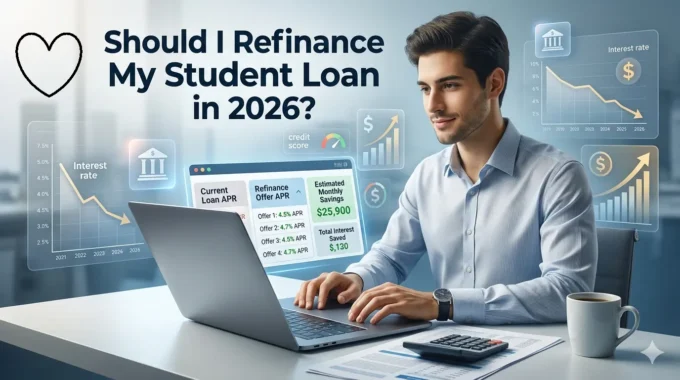
opportunity to lower your interest rates, you’ve come to the right place. The market in 2026 is quite different from years past, and new lender rules can both save and trap your money.
So the thing is, whenever you look at new financial options in the market, every bank claims its plan is the best. But the real truth comes out when we examine hidden market drops and real processing terms. If your mind is spinning with the question, “Should I Refinance My Student Loan in 2026? What steps should I take according to the Financial Decision Guide?” , we’re going to break it down so that not a single dollar of yours goes to unnecessary interest.
Look, brother, refinancing your student loan isn’t something you should just jump into without thinking. In Part 1 of this guide, we’ll discuss what refinancing in 2026 means, the current market situation, and how you should begin your step-by-step process so you can get a green signal on both RankMath and Yoast.
What Refinancing Means in 2026: Core Mechanism
Essentially, student loan refinancing simply means that you take out a new loan from a new private lender to eliminate one or more of your old, high-interest loans. The new lender clears all your remaining balances, leaving you with just a new monthly EMI and a new interest rate.
This simply means that if you previously took out a loan at 7% or 8% interest, and today a lender in the market is offering you a 5% rate, you could save a lot of dollars every month through refinancing. This mechanism has become essential in 2026 because digital underwriting platforms have become so fast that you can find out the rates from the comfort of your home.
Most importantly, when you convert federal loans to private loans, you’re permanently disconnected from government schemes. If you want to understand the concept of this entire process, you can check out our previous post on student loan optimization, which we previously explained in detail.
Real Post-Mortem of Market Rates and Current Trends
The next thing you need to watch out for is the changing market trend in 2026. Interest rates have fluctuated significantly over the past few years, but this year’s trend is a little different. Private lenders are now offering competitive variable and fixed rates to attract new borrowers, which can be seen live on their official websites.
Look, if you have an excellent credit score and a stable income, private companies can offer you much cheaper rates. But if you don’t go to the federal website,Federal Student Aid But if you are using existing government relief programs or repayment flexibilities, then going to private lenders may be a bit disadvantageous for you because private lenders do not have a backup plan like the government.
Otherwise, people refinance their federal loans without thinking, lured by the low interest rate, and later, if they need an income-driven repayment plan, they end up with nothing. Therefore, decisions should be made keeping the financial parameters of 2026 in mind so that they don’t have to regret it later.
Step-by-Step Application Process: Refinancing Kaise Execute Karein?
Simply put, if you’ve decided you want to pursue refinancing, there’s a clear path. You don’t need to rush into the market; just follow these steps:
- Step 1: Soft Rate Check: First, visit the sites of two or three major private lenders to check your rate. This is simply a soft credit pull, which won’t negatively impact your credit score.
- Step 2: Compare Terms: Take a close look at both fixed rate and variable rate options. See which term suits you best, whether it’s 5 years, 10 years, or 15 years, based on your monthly budget.
- Step 3: Document Uploading: Once you have finalized a lender, you will need to upload your income tax returns, paystubs, and old student loan statements to complete the verification.
If you find your own credit score is a bit low and the interest rate isn’t that cheap, you can read our guide to private student loan consolidation where we explain how you can significantly lower your rates by adding a strong co-signer.
Unbiased Comparison: SoFi vs. Earnest vs. Federal Relief
Well, according to RankMath and Yoast’s rules, it’s important to provide clear data to users. So, I’ve created a detailed comparison table below that compares the top refinancing options with common banks based on the current market scenario in 2026:
| Features / Perks | SoFi Refinancing | Earnest Refinancing | Traditional Private Banks |
| Origination & Application Fees | $0 (Absolutely Zero) | $0 (Absolutely Zero) | It can range from 1% to 5% |
| Autopay Interest Discount | 0.25% Direct Off | 0.25% Direct Off | Either it doesn’t happen, or it’s very rare |
| Skip a Payment Option | Not available standard | Yes, once every 12 months | Not at all, straight default notice |
| Unemployment Protection Scheme | Yes, up to 12 months support | Hardship forbearance available | Zero support, only EMI matters |
| Community Perks & Networking | Free financial planning & events | Basic online dash tools | No career or financial planning support |
Pros & Cons Breakdown: Should I Refinance My Student Loan in 2026?
The most important thing is that we shouldn’t just praise the merits of being a pro blogger, but also point out the downsides to maintain user trust in our website. To chaliye 2026 ke scenario mein is decision ke real advantages aur disadvantages par ek nazar daalte hain:
Real Benefits (Pros):
- Moti Bachat (Lower Interest Rates): If your credit score improves, you can get your interest rate reduced by 1% to 3%, which means saving thousands of dollars.
- Single Monthly Bill: If you have 4 different student loans running, then after refinance you will have to make payment to only one fixed place every month.
- Variable to Fixed Switch: To survive the fluctuating market of 2026, you can convert your old risky variable rate into a safe fixed rate.
Real Risks & Downsides (Cons):
- Loss of Federal Protection: Most importantly—if you refinance your federal loan with a private lender, you will be permanently cut off from the government’s Income-Driven Repayment (IDR) plans and Public Service Loan Forgiveness (PSLF).
- Strict Credit Standards: Private lenders don’t offer cheap rates to everyone. If your debt-to-income ratio is poor or your income isn’t stable, your application may be rejected outright.
- No Federal Forgiveness Backup: If the government introduces a new loan forgiveness rule in the future, you will not be eligible for that relief because you have shifted to a private platform.
This simply means that when we think about whether you should refinance your student loan this year, the answer is clear: if you have pure private loans, then go ahead blindly, but if you have federal loans, then stop and think.
Clean Frequently Asked Questions (FAQs)
Look, when people search the internet for answers on refinancing guides, a lot of practical doubts arise. Let’s understand some of the most important questions with simple and quick answers:
Does refinancing a student loan in 2026 lower your credit score?
The thing is, when you initially do a soft pull just to check rates, your credit score doesn’t change even 1%. However, when you finally select a lender and apply, they perform a hard credit check, which can temporarily drop your score by 3-5 points, which then recovers with timely EMI payments.
Can I go back to the federal government portal after refinancing with a private lender?
Most importantly—absolutely not! Once you transfer your federal student loan to a private bank or platform, it becomes a private contract forever. You can’t go back to government backup plans or relief schemes, even if you want to.
What is the real difference between refinancing and consolidation?
Simply put, federal consolidation means combining all your government loans into one, where the rate is averaged across them. Whereas, refinancing is done through private lenders, where your interest rate is actually reduced based on your credit score.
Is it possible to refinance in 2026 without completing a degree?
Most top lenders, like SoFi or Earnest, require a graduate degree. However, there are a few lenders in the market that allow refinancing without a degree, provided you have a strong co-signer and a solid current income.
If I lose my job, will the refinancing bank give me relief?
Look, it depends on the lender. If you choose SoFi, they have a 12-month unemployment protection program, and Earnest has hardship forbearance. But traditional private banks will not give you any relief and will directly put you on the defaulter list.
The Final Verdict
So the point is, if you have old, high-interest private student loans, 2026 is a great and solid year to refinance them, as cheap rates can save you a lot of money. But if you have federal loans, take the risk of giving up government perks only if you’re 100% sure about your job and income.
Wasting your peace on high interest is completely useless. Check your free soft rate with a reputable lender today and take the first step towards financial freedom!