College education fees are rising at a rapid pace every year. Consequently, most students are forced to take out loans for higher education. But the biggest confusion arises when people ask, ” Will student loan interest rates change? Will your monthly EMIs increase or decrease based on market trends for 2026 ?”
The point is, there’s no single-line answer. It depends entirely on the type of loan you took out and the prevailing market conditions. If you’re considering a new loan this year or are worried about an old one, understanding market trends is crucial. In this guide, we’ll break down the entire mechanism in simple terms so you don’t suffer financial losses.
The Real Mechanism: Federal vs Private Student Loans
Look brother, if you want to understand whether student loan interest rates really change, then first of all you have to identify the source of your loan.
There are mainly two types of financial structures:
Federal Student Loans (Government Funded)
Basically, if your loan is approved by the US Department of Education or any other government statutory body, its rate is completely fixed for the life of the loan. Once the rate is locked, it will not change.
But there’s a twist—every year on July 1st, the government sets new interest rates for the new academic year. This means old borrowers are not affected, but new borrowers receive fresh market pricing.
Private Student Loans (Bank/Fintech Funded)
This is where the game changes completely. Private lenders like SoFi, Earnest, or local financial providers give you two options: Fixed Rate and Variable Rate.
If you’ve selected a variable rate, your interest rate will change monthly or quarterly based on market interest benchmarks. This simply means that if the central bank increases the rate, it will directly impact your pocket.
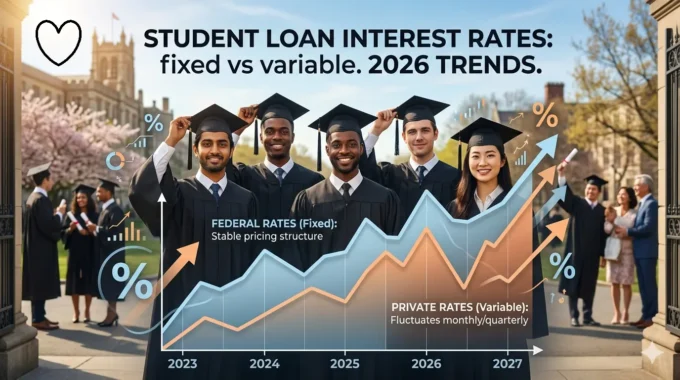
As you can see in the chart above, fixed rates remain fairly stable throughout the time period (Scenario A), while variable rates can fluctuate significantly based on market metrics (Scenario B).
Market Trends for 2026: What’s Happening Right Now?
The interest rate environment is expected to see significant changes, according to financial indicators for 2026. Rising global tuition fees and inflation are impacting student loan funding pricing.
- Federal Benchmark Shifts: For the 2026-2027 academic year, the interest rate for Direct Undergraduate Loans is approximately 6.52% , while the rate for Parent PLUS loans is touching 9.07% .
- The Federal Reserve Impact: The monetary policies of the US Fed and global central banks are now becoming somewhat stable, due to which there are not many sudden swings in the rates of private variable loans.
- Fintech Underwriting Change: Digital platforms like SoFi and Earnest now consider a student’s potential career earnings in addition to traditional credit scores. This is helping creditworthy graduates find better rates on refinance options.
If you are planning a new loan, you may have to tighten your budgeting a bit as per this year’s trends as pricing is moving well above historically low levels.
How to Manage and Optimize Your Interest Rates
If you’re wondering if we can avoid the losses of interest rate hikes, the answer is yes! By taking a few practical steps, you can completely mitigate this risk.
Step 1: Maximize Federal Subsidized Resources
First of all check whether youFederal Student AidYou are eligible for a subsidized loan as per the . The biggest advantage of a subsidized loan is that the government pays the interest for the entire time you are studying in college.
Step 2: Set Up Autopay Discounts
Most private and public institutions offer a simple feature—Autopay. If you set up an automatic monthly direct debit from your bank account, lenders offer a flat 0.25% interest rate discount . This may seem like a small number, but it could save thousands of dollars in the long run.
Step 3: Evaluate Refinancing Options
If you had a variable rate loan and market rates are going up, you can convert them to a fixed rate. You can also consult industry leaders likeSoFi Student Loan RefinancingYou can track rates and if your credit score improves, you can lock in lower rates.
Otherwise, if you implement the variable plan without thinking, then during the market hike, both your repayment period and debt trap will increase.
Unbiased Competitors/Alternatives Section
In fact, if you simply stick to standard public or private debt, market volatility will cause you problems. Therefore, there are some alternative routes in the market where the direct pressure of “Do Student Loan Interest Rates Change? Market Trends for 2026 ” doesn’t fall on your pocket.
Let’s delve deeper into the two biggest financial alternatives:
1. Income Share Agreements (ISAs)
Look, this is a very solid competitor to the traditional loan structure. ISAs don’t have any fixed or variable interest rates. Some colleges and specialized institutions teach you without any upfront fee. In return, when you get a job after graduation, you have to pay a fixed percentage (like 10% or 15%) of your salary to them for a limited time period.
- The biggest advantage: If you lose your job or your salary is reduced, your monthly payment is reduced based on the same parameters. There’s no chance of interest rates increasing or decreasing.
2. Peer-to-Peer (P2P) Lending Platforms
The next thing is P2P financing networks. Investors on Funding Circle or other online platforms provide funding directly to students. Rates here depend entirely on your academic performance and credit structure, not on Federal Reserve banking policies. If you have a good track record, you may be able to get better fixed terms than private banks.
Custom Data Table & Pros/Cons
Most importantly, you need clear numbers to analyze market trends. The custom data table below lets you see the pricing differences for 2026 in simple terms:
| Loan Category (2026 Metrics) | Avg Interest Rate Range | Rate Type Mechanism | Best Suited For |
| Federal Undergraduate | 6.39% – 6.52% | Strictly Fixed Term | Maximum stability chahne wale students |
| Federal Parent PLUS | 8.94% – 9.07% | Strictly Fixed Term | For parents of dependent students |
| Private Fixed Route | 4.50% – 14.00% | Locked-in Market Price | Excellent credit score wale individuals |
| Private Variable Route | 3.50% – 15.50% | Fluctuates Monthly/Quarterly | Short-term payoff target karne wale borrowers |
Pros and Cons: Fixed vs Variable Interest Rates
Every coin has two sides, and the same is true with these financial products.
Fixed Interest Rates
- Pros: Your monthly EMIs remain rock-solid and stable. No matter how high the market rises, your payment structure remains unchanged, making monthly budgeting flawless.
- Cons: Even when the overall market interest rate drops, your rate will remain stuck at the same high levels until you refinance it.
Variable Interest Rates
- Pros: Variable rates are initially much lower than fixed loans (with introductory discounts), which can save a lot of money for short-term loans.
- Cons: The risk factor is very high. If macroeconomic conditions worsen in the remaining months of 2026, your overall debt value could suddenly shoot up.
Clean FAQs Section
Do student loan interest rates change after graduation? If your loan is federal, it won’t change at all because it’s fixed. However, if you have a private variable loan, your rate will continue to fluctuate after graduation based on market benchmarks until you refinance it to a fixed configuration.
Can I convert my variable student loan rate to a fixed rate? Yes, you absolutely can. The easiest way to do this is “refinancing.” You’ll need to go to another private lender (like SoFi or Earnest) who will pay off your current variable loan and generate a new, single fixed-rate loan balance.
How often do private student loan interest rates change? This simply depends on the lender’s terms. Most private platforms evaluate variable loans on a monthly or quarterly basis. They adjust rates based on index tracking systems like Libor or SOFR.
Does federal student loan consolidation change your interest rate? Basically, when you consolidate federal loans, your new rate is the weighted average of all your previous loans rounded up to the nearest one-eighth percent. This rate never changes, but becomes a new fixed rate.
What happens if market interest rates crash in late 2026? If rates fall, variable loan borrowers will receive direct relief and their EMIs will automatically reduce. Fixed loan borrowers will not receive this direct benefit; they will have to seek refinancing assistance to receive the new lower market rate.
Call to Action (CTA)
Stop worrying about the market’s ups and downs, brother—get your loan documents out today, check whether you’re in the fixed or variable bracket, and start saving your extra money with the steps above!